
A long time ago, early industry businesses required manual procedures in order to remain in top working condition. When industrialization became the new normal, manufacturing companies took the lead with newer technologies as they emerged. As manufacturing businesses expanded and competition between manufacturers became more aggressive, the industry couldn’t keep up with demands from manual processes and machinery alone. This is when the industry turned to automation to stay on top of emerging needs.
Automated technology has made waves and continues to further the efficiency of businesses worldwide. There is no longer a need for excessive manual labor in order to keep up with production, which has helped these businesses grow exponentially. With the continued success of this autonomous machinery, the need to make sure that these machines are calibrated and in working order is more important than ever.
Using machines is quite efficient since it reduces the amount of risk that employees are subjected to and they can work longer hours and at a quicker pace. However, machines still do suffer from problems of their own — this is where calibration comes in.
Calibrating a machine means checking an automated device or machine to ensure accuracy. You can calibrate a machine by comparing it to the industry standard. It’s usually best practice to maintain a record of calibration processes to ensure optimal function and compliance with standards. The important things to compare in each calibration report are:
These factors will determine how often you need to conduct calibration tests. You must conduct these tests consistently throughout the time that each device or piece of machinery is in use. The frequency of scheduling calibration tests will vary, however.
For example, if your machine has undergone some form of damage or is older and has signs of deterioration, you may need to schedule more frequent calibration tests. The amount of work that the machine does, the importance of the machine to your business’s function and the overall stability of the machine all play a part in determining how often you need to calibrate.
In general, you should calibrate machinery once every year. The timeline for this can change based on varying needs, such as devices that require more frequent fine-tuning. Machinery that seems to be in working order during every annual check with no adjustments necessary can push calibrations back to every two years instead.
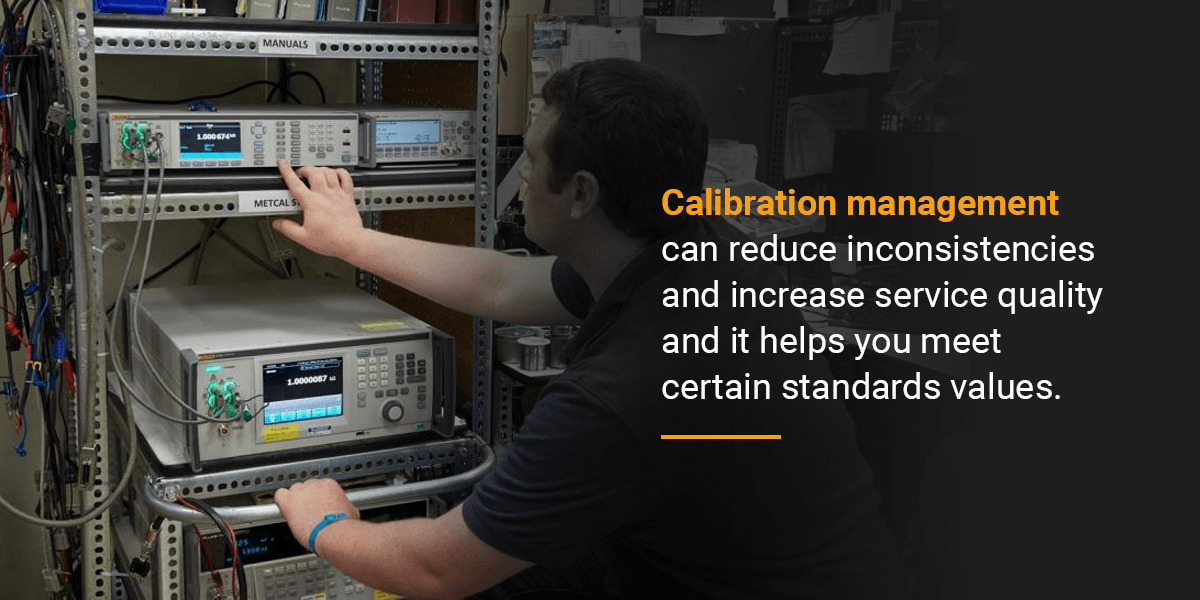
Calibration management is important in manufacturing due to the role it plays in ensuring accuracy, a huge aspect of the overall quality and performance of manufacturing machinery. Calibration management can reduce inconsistencies and increase service quality and it helps you meet certain standard values. Regular calibration also keeps working environments safe and keeps machinery and devices in working order for a longer period of time. This reduces overall costs for businesses that would otherwise have to spend money to frequently replace vital equipment.
Calibration tests are critical in maintaining efficiency across legacy and state-of-the-art equipment. However, you can only stay up to date with your calibration activities if you have a reliable calibration management software.
Calibration management software (CMS) is a program designed to assist with scheduling calibration activities and procedures. This software also has the ability to schedule preventive maintenance, collect and backup your files for safe storage and future reference.
Every monitoring software works differently and can fulfill the needs of different industries. However, all systems typically share certain key factors. The way calibration systems like these work may seem complex, but here is how it all breaks down:
CMS offers calibration automation by handling all scheduling and certain manual tasks. Since the system is automated, it can help you maintain accurate records and access them when you need them.
The automation streamlines workflow, reducing reliance on certain manual tasks. As the tests are conducted, the automated system can also compile the reports and sort the information efficiently so that it is accessible to the equipment manager. The need to sort this information into a pile of spreadsheets is no longer required. CMS also has the ability to make recommendations based on its findings.
CMS gets rid of the need for equipment managers to determine the requirements for the calibration tests. Instead, the system uses the current data and information from past tests to determine what requirements need to be fulfilled during the calibration. This helps streamline the process just a little bit more, making the staff’s jobs a bit easier.
The automated CMS can also build a recommended action procedure for calibration testing. Once the requirements have been determined, then actions must be taken to conduct the test and ensure that all testing requirements have been fulfilled. A CMS will help make sure that a plan is made for testers to follow based on recommendations from the system as well as the equipment manager.
Here are the key benefits of investing in a calibration management system:

A CMS can produce a set of instructions for the staff that will be conducting the calibration procedures. These instructions are made based on the information found during previous tests and once the requirements were determined. This can also include instructions for safety during the testing. These instructions help minimize risks by reducing the chances that a system is improperly calibrated or that a staff member gets injured during the process.
Using a CMS will help you save time, which in turn, helps you save money. Manual documentation is no longer necessary and the quick access of records and accurate calibration keep mistakes from happening, reducing the chances that equipment needs to be fixed or entirely replaced.
Automation is making everything more efficient for industries everywhere, and the same can be said about CMS. With this system, employees can spend more time elsewhere and quick and efficient calibration helps speed up the workflow. Because of this, manufacturing plants are able to produce more at a quicker rate than they would be if they were conducting their calibrations manually.
Maintaining calibration schedules and remaining compliant with standards is easier with the right calibration management software.
There are plenty of equipment calibration software solutions. What you choose depends on your needs and preferences. For example, you could start with a free calibration management software and upgrade to a paid version when you’re comfortable with the provider.
Here are a few examples of CMS options:
IndySoft is a best-in-class calibration management software solution for efficiency and precision. This innovative CMS is informed by decades of experience serving manufacturing, automotive, aerospace, defense and other industries. It offers an out-of-the-box best practices configuration, but also extensive customization capabilities.
Key features:
Beamex is a leading calibration management software program, offering comprehensive solutions. It’s designed to assist organizations across industries in planning, managing and executing calibration activities. As an all-in-one solution, Beamex CMX comes as a fully integrated and automated system offering efficient and auditable processes.
Key features:
MET/CAL® is another robust calibration management software. The software offers exceptional capabilities when it comes to managing calibration workloads.
Key features:
GageList is a reliable cloud-based calibration management software designed to provide flexibility in managing measuring tools and equipment. The simple online access eliminates the need for on-premise desktop installations. It offers companies management accuracy in line with quality standards.
Key features:
As a cloud-based calibration management software, Metquay offers robust tools to streamline calibration processes. It’s a go-to software to automate workflows and maintain calibration compliance.
Key features:
A properly calibrated machine will work at its best and its efficiency will provide your business with increased productivity. Using a calibration management solution is one way to help along the process, but working with a calibration professional can make it even more efficient.

Garber Metrology has a team of calibration professionals who are highly trained and experienced in calibration. Partnering with a calibration company has many advantages.
Firstly, you’re more likely to save money if you work with a professional as opposed to doing the calibration yourself. No money has to be spent on training and these professionals can often work quickly with more accurate results.
Since calibration has to be as accurate as possible, it is also important that a secure lab environment is created. This can be difficult for businesses that attempt to calibrate in-house. Calibration companies, however, already have this environment available to them, along with special equipment and measures in place to make sure they meet the standards set for different industries. This saves businesses valuable time and money
You’ll often experience quicker turnaround rates as well when you work with a calibration company. Since these companies are solely focused on calibration, they can get the work done sooner than in-house members who may have other priorities or obligations to focus on first.
Calibration professionals will also typically provide you with a calibration certificate once the measurements and calibrations have been completed. This means that you now have verifiable proof for your records that calibration was done and that your machinery has been measured and assured of its accuracy.
Keeping your equipment in working order is an important part of running a successful business. And equipment needs constant maintenance and calibration to keep up with rising demands. While calibration management can seem difficult, there are professionals who can help you streamline the process.
Garber Metrology offers precision calibration services to help keep your equipment in peak physical condition. You no longer have to worry about staying on top of your calibration schedule — our highly trained and qualified staff have got you covered. Calibration has never been easier than if you partner with Garber Metrology.
Contact us today to request a quote and speak with a representative about calibration solutions for your equipment.
